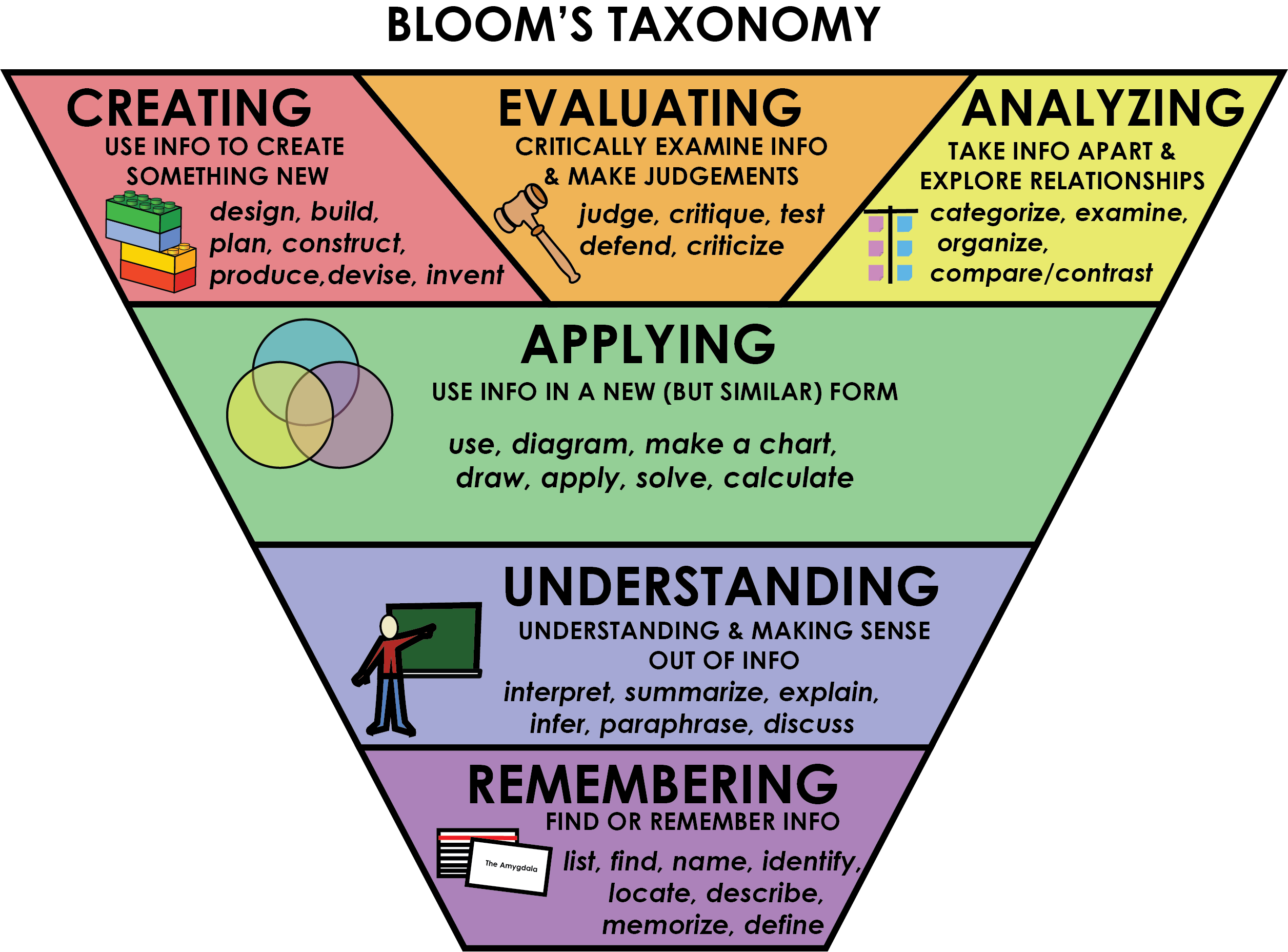
Attribution: [Image](Blooms-Graphic.png (2512×1856)) licensed under CC BY-SA 4.0. No modifications made.
Bloom’s Taxonomy, especially the 2001 Revised Version, is an essential framework for structuring cognitive and language development in university-level CLIL (Content‑Language Integrated Learning) and SIOP (Sheltered Instruction Observation Protocol) settings. Here’s a comprehensive look tailored for professors:
🎓 Bloom’s Revised Taxonomy Overview
1. Dual Dimensions
This two-dimensional structure enables educators to form clear, multi-layered objectives—e.g., “Apply procedural knowledge” by solving discipline‑specific problems.
2. Hierarchical—but Interconnected
Integration with CLIL and SIOP
CLIL (Content and Language Integrated Learning)
- Effective CLIL designs embed higher-level cognitive tasks (Apply, Analyze) within language-rich contexts.
- For example, Ortiz‑García & Navarrete‑Villarraga found primary students in Colombia developed strong Apply and Analyze skills while acquiring both factual and procedural knowledge—and even metacognitive insights—through CLIL instruction. [files.eric.ed.gov]
- Emphasizes procedural and metacognitive dimensions, vital for students to internalize how they think and learn in a multilingual setting.
SIOP (Sheltered Instruction)
- Aligns content and language objectives: e.g., students will Analyze data (content objective) and Explain reasoning in English (language objective).